Two very different products both answer to the name “pennant flag,” and most ordering confusion starts right there. One is the felt keepsake pennant, the triangular banner that hangs on a wall to mark a team, a school, or an event. The other is the string pennant banner, a run of small triangles strung along a cord to decorate a lot, a grand opening, or a fair. They share a shape and nothing else about how you spec them. This guide focuses on the physical decisions that actually change the price and the finished piece: size, felt or fabric, and how the pennant is finished and hung.
Start by choosing the pennant family
The felt wall pennant is the classic collectible: a single triangle, usually felt, printed or appliqued with a name and graphic, meant to be seen up close and kept. It rewards heavier material and cleaner decoration because people handle it. The string pennant banner is an outdoor decoration built for distance and weather, made from lightweight polyester or vinyl triangles sewn to a long cord, where the job is visibility and coverage rather than a keepsake feel. A third category, the single marketing pennant, sits between them: one larger printed triangle flown from a pole or wall bracket to draw attention to a storefront. Naming which of these you want first prevents almost every downstream mismatch, because each family uses different sizes, materials, and finishing.
Sizes: what the common tiers actually measure
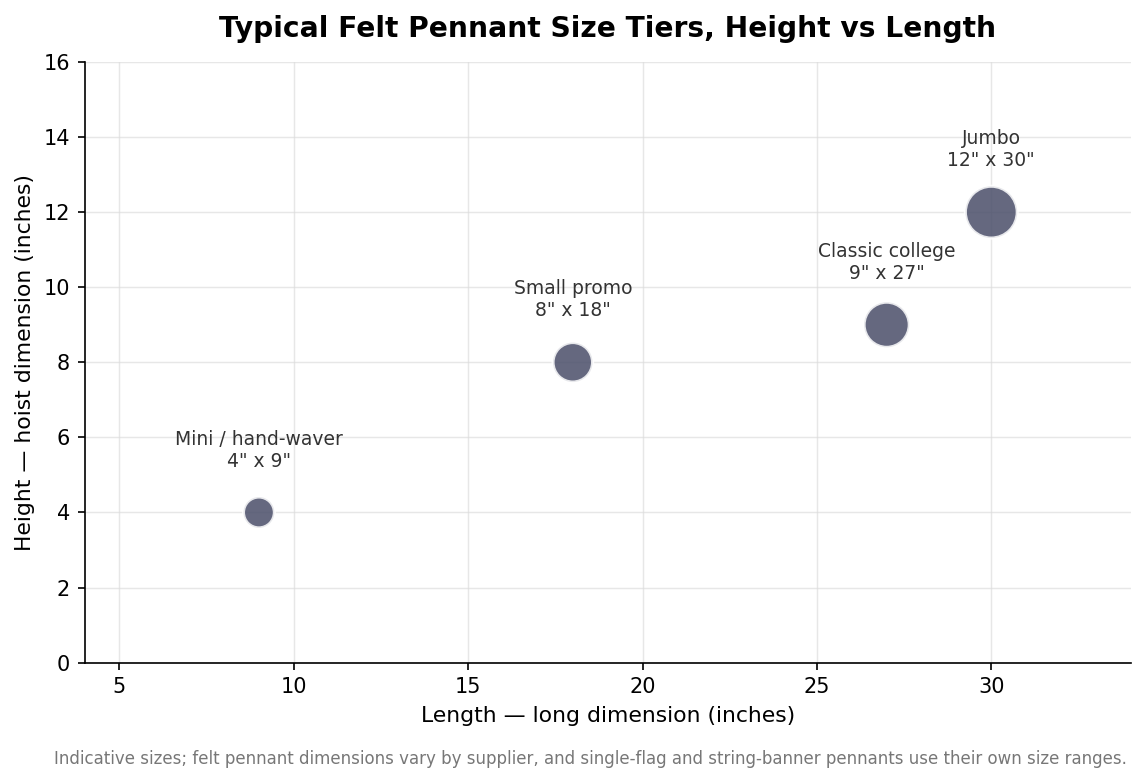
Felt wall pennants cluster into a handful of tiers. A mini or hand-waver pennant runs around 4 by 9 inches and works as a giveaway or stick flag. A small promotional pennant is roughly 8 by 18 inches, the size most often printed in quantity for events. The classic college pennant is about 9 by 27 inches, the long silhouette most people picture when they hear the word. A jumbo pennant reaches roughly 12 by 30 inches for a display piece meant to fill a wall. These are indicative sizes rather than fixed standards, and suppliers trim them differently, so confirm the exact dimensions on a quote before you commit artwork.
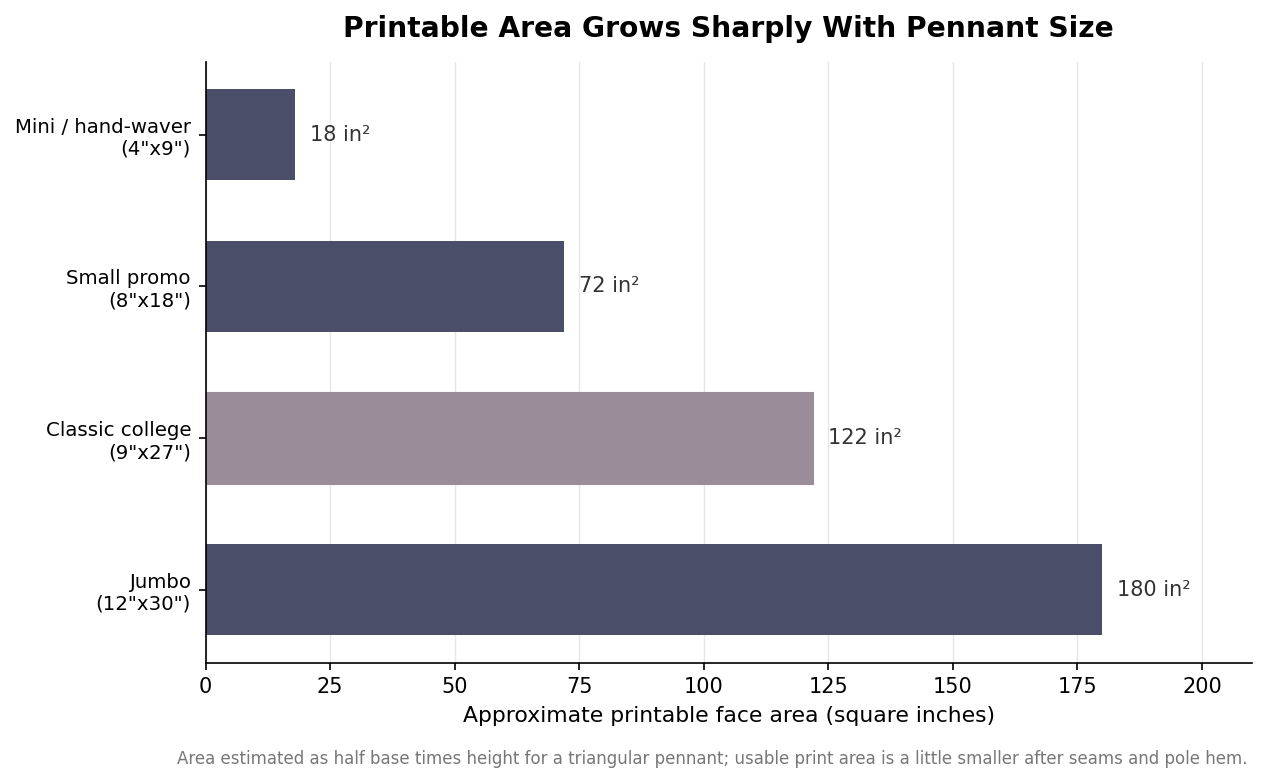
The reason size deserves real thought is that printable area does not grow gently as the pennant gets longer. Because a pennant is a triangle, its face area is roughly half the base times the height, so stepping from a small 8 by 18 to a classic 9 by 27 roughly doubles the room for a logo and lettering. If your design has a wordmark plus a graphic, that jump often decides whether the text is comfortably readable or crammed against the seams.
Single marketing pennants and string banners use their own scales. A popular single-flag size is around 12 by 18 inches, with larger formats measured in feet for pole use, while string-banner triangles are commonly in the 9 to 12-inch range and are specified by the strand length, often anywhere from 30 to 100 feet, rather than by the individual flag. Match the size language to the product family so you are comparing like with like.
Felt and fabric: matching material to purpose
For wall pennants, the material choice is usually a felt type, and the tradeoff is durability and feel against cost. Wool felt is thicker, denser, and noticeably softer, and it holds up as a keepsake, which is why heirloom-grade pennants lean on it, but it costs more than synthetic alternatives. Polyester and acrylic felt are budget-friendly and print well, though they are thinner and a little scratchier, which is perfectly acceptable for a promotional run that does not need to last decades. Many custom pennants use a synthetic felt precisely because it balances a clean printed look against a price that works in volume.
String and single marketing pennants move away from felt entirely. They are typically polyester for a stitched, reusable banner or vinyl and plastic for the cheapest disposable strands, chosen for weather resistance and low weight rather than hand feel. If a banner will live outdoors for a season, a hemmed polyester strand outlasts a plastic one by a wide margin, and the cost difference is usually modest across a single strand.
Decoration and finishing details that change the result
How the design goes on the pennant matters as much as the material. Screen printing lays opaque ink on felt and gives bold, simple graphics at low unit cost in volume, and it works well on felt despite the fabric’s texture. Applique and chenille letters are stitched-on pieces that add dimension and a varsity look, raising cost but also perceived value for keepsakes. Dye sublimation prints full-color, edge-to-edge designs and suits polyester banners better than felt, since it relies on polyester fibers to take the dye. Choosing the decoration method and the material together, rather than in sequence, keeps you from pairing, say, a photographic full-color design with a felt that cannot reproduce it.
Finishing is the detail buyers forget until the pennant arrives. Wall pennants are usually finished with a sewn pole hem or a header strip so they hang straight, and some add a wooden dowel or a hanging cord. String banners need the triangles sewn into a reinforced cord with enough lead line at each end to tie off, and grommets or tabs if they will be tensioned. Spelling out the hanging method on your order, alongside size and material, is what turns a good-looking proof into a pennant that actually installs cleanly where you intend to use it.