Category: Uncategorized

  • String Pennant Banners: Sizing, Materials, and Coverage That Fits the Job

    String Pennant Banners: Sizing, Materials, and Coverage That Fits the Job

    Search for a custom pennant and you will find two products wearing the same name. One is the stiff felt triangle that hangs on a bedroom wall or gets handed out at a reunion. The other is a long string of small flags strung between poles to draw the eye at a grand opening or along a car lot. They solve different problems, and buying the wrong one is a common and avoidable mistake. This guide is about the second kind, the string pennant banner, and how to size, specify, and buy it so it does the job you actually hired it for.

    String pennants are attention infrastructure, not keepsakes

    A felt wall pennant is a memento; people keep it. A string pennant banner is a piece of temporary visual infrastructure whose only job is motion and color across a wide space. It works because a row of small triangles flutters in the wind and creates a moving edge that the human eye tracks from a distance. That difference in purpose drives every spec decision that follows. You are not buying one beautiful object, you are buying linear coverage that reads from the road, so the questions that matter are how long a run you need, how it will be mounted, and how long it has to survive outdoors.

    The individual flags are deliberately small. Custom string pennants are commonly offered in two sizes, about 6 by 10 inches and about 8 by 12 inches, in either a triangle or a rectangle. The larger size sits closer together on the line, with published spacing around 2 inches between flags versus roughly 4 inches for the smaller pennant. Neither flag is meant to be read up close; the design that works is a bold shape or a single color rhythm, not fine print.

    Sizing a run: length, flag count, and coverage

    String pennants are sold by the length of the flagged section, and the flag count scales almost linearly with it. Standard configurations run from a 10 foot string of 12 pennants up to a 75 foot string of 90 pennants, which works out to roughly 1.2 flags per foot across the whole range. Most suppliers also add about 5 feet of plain, flagless string at each end so you have something to tie off to a pole or hook without burying the first flag in a knot.
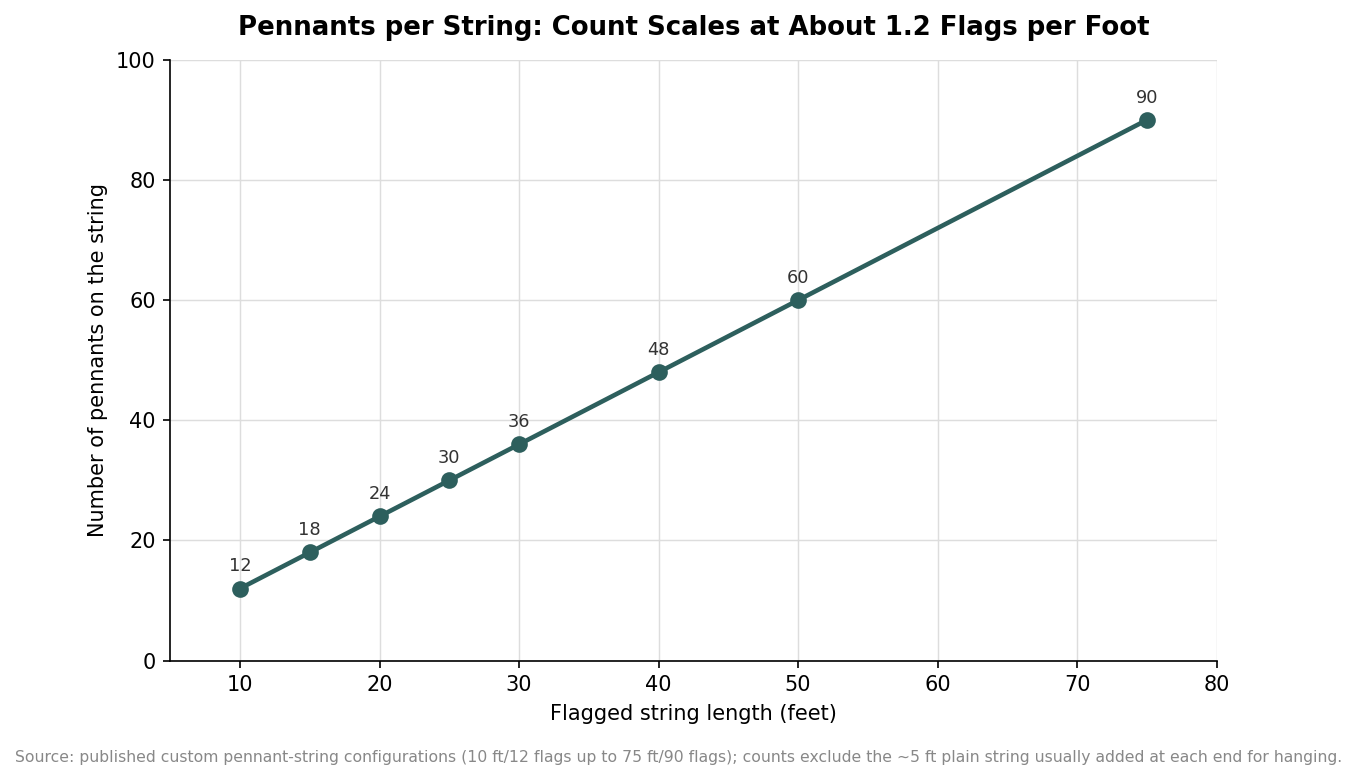
    Line chart showing pennant count rising from 12 flags on a 10 foot string to 90 flags on a 75 foot string, about 1.2 flags per foot
    Pennant count rises almost linearly with string length, near 1.2 flags per foot.

    That plain-end detail matters when you plan a span, because the flagged length is the part that decorates and the plain ends are mounting allowance on top. If you need to cover a specific width, estimate the pennants at about 1.2 per linear foot of the space you want to animate, then choose string lengths that add up to that span with a little overlap where two strings meet. A single 25 foot storefront takes something on the order of 30 flags, while a 200 foot dealership row climbs toward 240, which is where buying by the longest available strings and joining them becomes the efficient move.
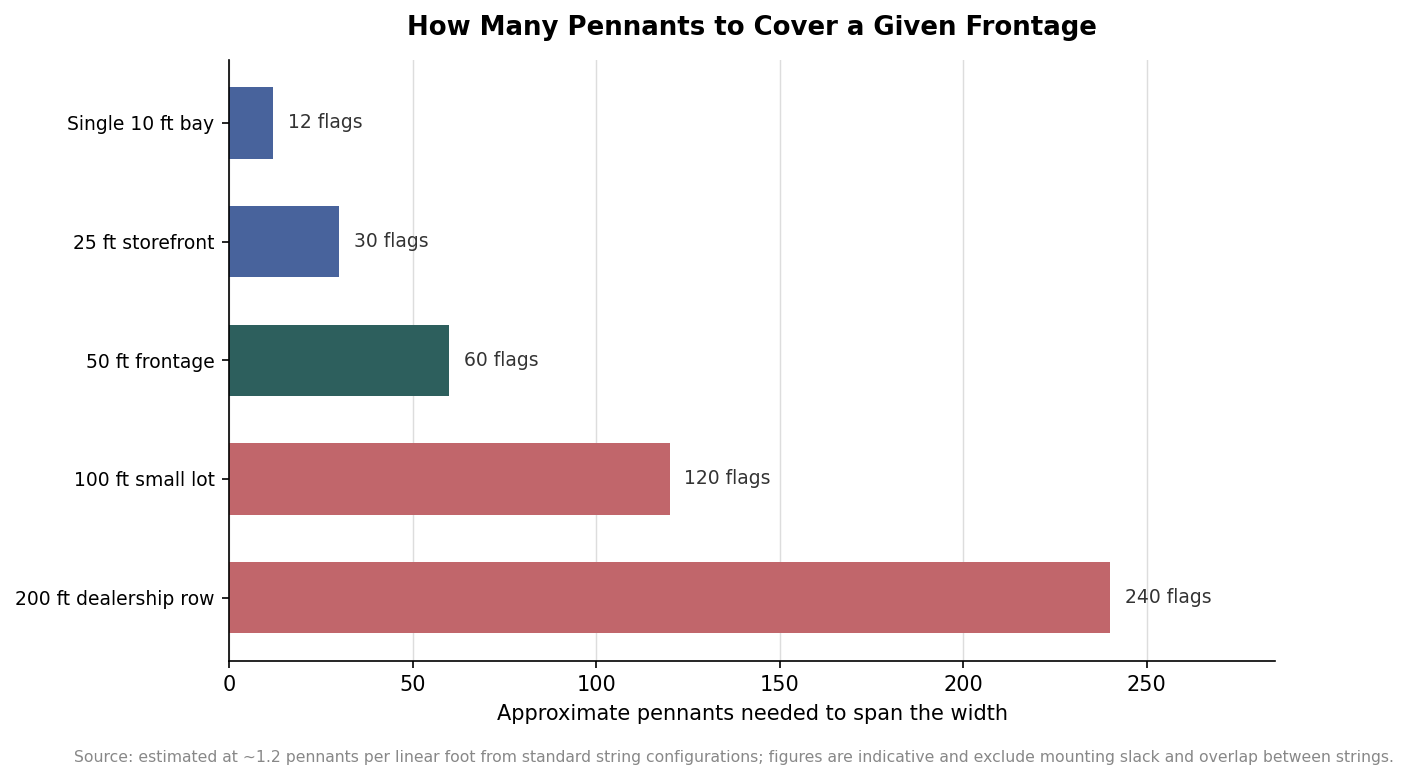
    Horizontal bar chart of approximate pennants needed to span frontages from a 10 foot bay up to a 200 foot dealership row
    Estimated pennants to span common frontages at about 1.2 flags per linear foot.

    Material and print: matching the banner to the weather

    The material decision comes down to where the banner lives and how long it needs to last. Vinyl is the economical, high-opacity option; a 13 ounce vinyl prints boldly and is well suited to indoor use and short outdoor promotions, though the most economical grades are single-sided, which means the design reads in reverse on the back. Fabric, typically a lightweight knitted outdoor polyester around 3.25 ounces per square yard, is the choice when the run has to move in the wind and take weather, because it is tear-resistant and flutters more freely than heavier vinyl.

    Sidedness is the spec buyers forget. If your pennants hang where people approach from both directions, a single-sided print leaves half your audience reading a mirror image or a blank back. Double-sided construction sews two prints together, often with an inner liner, so the message is correct from either side. It costs more and adds a little weight, so reserve it for placements where both faces are genuinely seen, such as a string crossing a driveway, and save the single-sided economy for runs mounted against a wall.

    Durability claims in this category are usually phrased as weather-resistant and UV-protected rather than as a guaranteed number of months, and that vagueness is honest, because lifespan depends heavily on sun exposure, wind, and how the string is tensioned. Treat outdoor pennant strings as a season-scale product, not a multi-year fixture, and plan to refresh them when the color fades or the edges begin to fray.

    How to specify an order that actually fits the job

    Start from the space, not the product. Measure the width you want to animate, convert it to a flag count at roughly 1.2 per foot, and then pick string lengths that reach that span with mounting slack at each end. Decide sidedness based on approach angles, choose vinyl for indoor punch or fabric for outdoor movement, and keep the artwork bold enough to read at the speed of passing traffic. If you are torn between the two flag sizes, the larger 8 by 12 inch pennant gives a denser, more continuous band of color, while the smaller 6 by 10 inch flag stretches your budget further over a long run.

    The mistake to avoid is treating a string pennant like a felt keepsake and obsessing over close-up detail, or treating a felt keepsake like signage and ordering it by the foot. Name the job first. If you want something guests take home, that is a felt pennant and a different spec conversation. If you want a wide space to look busy and alive from the road, size the string by coverage, match the material to the weather, and let the wind do the rest.
  • Custom Pennant Sizes, Felt, and Finishing: A Practical Spec Guide

    Custom Pennant Sizes, Felt, and Finishing: A Practical Spec Guide

    Two very different products both answer to the name “pennant flag,” and most ordering confusion starts right there. One is the felt keepsake pennant, the triangular banner that hangs on a wall to mark a team, a school, or an event. The other is the string pennant banner, a run of small triangles strung along a cord to decorate a lot, a grand opening, or a fair. They share a shape and nothing else about how you spec them. This guide focuses on the physical decisions that actually change the price and the finished piece: size, felt or fabric, and how the pennant is finished and hung.

    Start by choosing the pennant family

    The felt wall pennant is the classic collectible: a single triangle, usually felt, printed or appliqued with a name and graphic, meant to be seen up close and kept. It rewards heavier material and cleaner decoration because people handle it. The string pennant banner is an outdoor decoration built for distance and weather, made from lightweight polyester or vinyl triangles sewn to a long cord, where the job is visibility and coverage rather than a keepsake feel. A third category, the single marketing pennant, sits between them: one larger printed triangle flown from a pole or wall bracket to draw attention to a storefront. Naming which of these you want first prevents almost every downstream mismatch, because each family uses different sizes, materials, and finishing.

    Sizes: what the common tiers actually measure

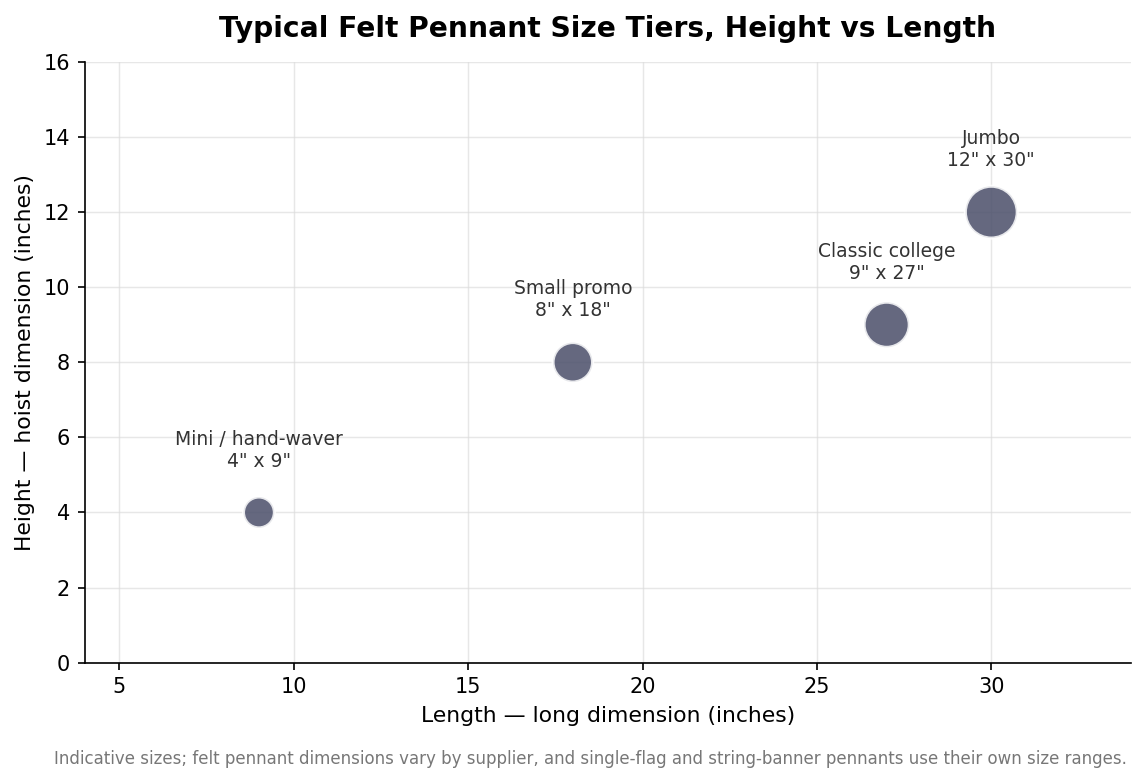
    Felt wall pennants cluster into a handful of tiers. A mini or hand-waver pennant runs around 4 by 9 inches and works as a giveaway or stick flag. A small promotional pennant is roughly 8 by 18 inches, the size most often printed in quantity for events. The classic college pennant is about 9 by 27 inches, the long silhouette most people picture when they hear the word. A jumbo pennant reaches roughly 12 by 30 inches for a display piece meant to fill a wall. These are indicative sizes rather than fixed standards, and suppliers trim them differently, so confirm the exact dimensions on a quote before you commit artwork.

    Scatter plot of felt pennant size tiers plotted by height and length in inches
    The common felt pennant tiers, from a 4-by-9 mini to a 12-by-30 jumbo, plotted by height and length.

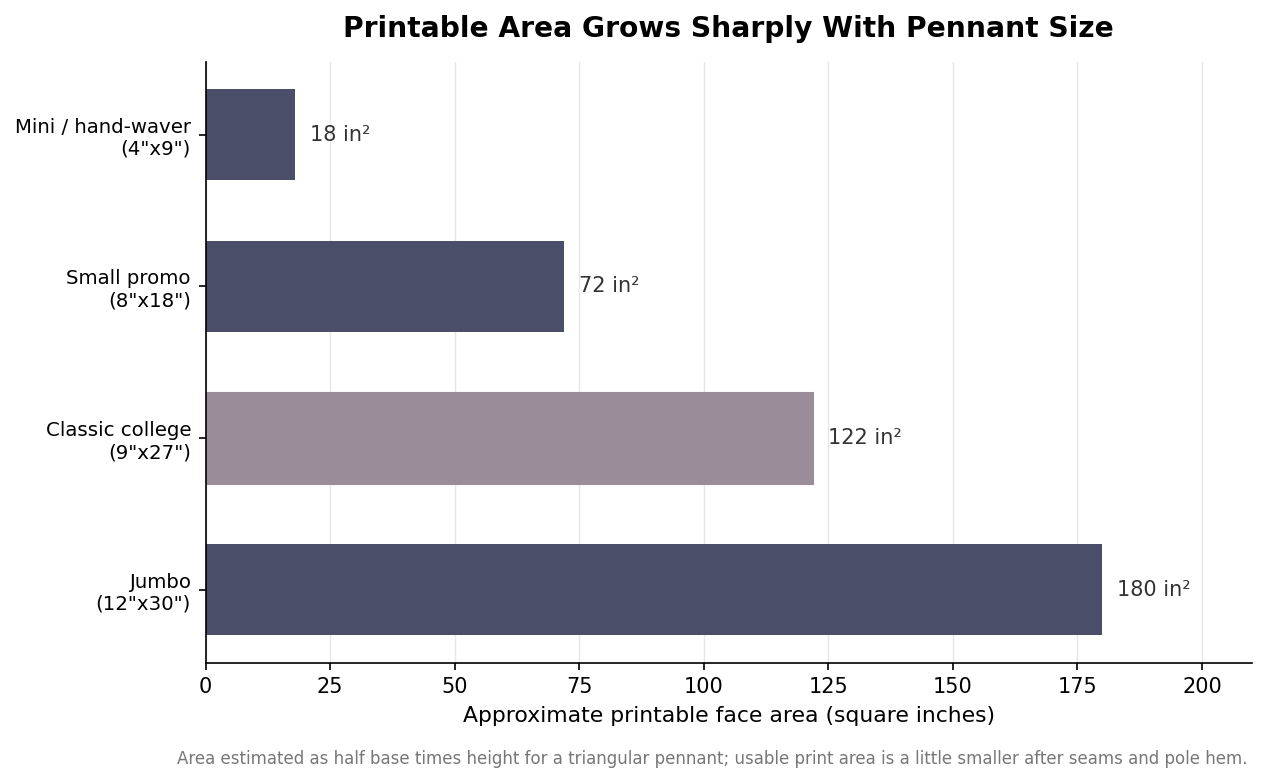
    The reason size deserves real thought is that printable area does not grow gently as the pennant gets longer. Because a pennant is a triangle, its face area is roughly half the base times the height, so stepping from a small 8 by 18 to a classic 9 by 27 roughly doubles the room for a logo and lettering. If your design has a wordmark plus a graphic, that jump often decides whether the text is comfortably readable or crammed against the seams.

    Horizontal bar chart of printable triangle area in square inches by pennant size tier
    Because a pennant is a triangle, printable area rises steeply as the size tier increases.

    Single marketing pennants and string banners use their own scales. A popular single-flag size is around 12 by 18 inches, with larger formats measured in feet for pole use, while string-banner triangles are commonly in the 9 to 12-inch range and are specified by the strand length, often anywhere from 30 to 100 feet, rather than by the individual flag. Match the size language to the product family so you are comparing like with like.

    Felt and fabric: matching material to purpose

    For wall pennants, the material choice is usually a felt type, and the tradeoff is durability and feel against cost. Wool felt is thicker, denser, and noticeably softer, and it holds up as a keepsake, which is why heirloom-grade pennants lean on it, but it costs more than synthetic alternatives. Polyester and acrylic felt are budget-friendly and print well, though they are thinner and a little scratchier, which is perfectly acceptable for a promotional run that does not need to last decades. Many custom pennants use a synthetic felt precisely because it balances a clean printed look against a price that works in volume.

    String and single marketing pennants move away from felt entirely. They are typically polyester for a stitched, reusable banner or vinyl and plastic for the cheapest disposable strands, chosen for weather resistance and low weight rather than hand feel. If a banner will live outdoors for a season, a hemmed polyester strand outlasts a plastic one by a wide margin, and the cost difference is usually modest across a single strand.

    Decoration and finishing details that change the result

    How the design goes on the pennant matters as much as the material. Screen printing lays opaque ink on felt and gives bold, simple graphics at low unit cost in volume, and it works well on felt despite the fabric’s texture. Applique and chenille letters are stitched-on pieces that add dimension and a varsity look, raising cost but also perceived value for keepsakes. Dye sublimation prints full-color, edge-to-edge designs and suits polyester banners better than felt, since it relies on polyester fibers to take the dye. Choosing the decoration method and the material together, rather than in sequence, keeps you from pairing, say, a photographic full-color design with a felt that cannot reproduce it.

    Finishing is the detail buyers forget until the pennant arrives. Wall pennants are usually finished with a sewn pole hem or a header strip so they hang straight, and some add a wooden dowel or a hanging cord. String banners need the triangles sewn into a reinforced cord with enough lead line at each end to tie off, and grommets or tabs if they will be tensioned. Spelling out the hanging method on your order, alongside size and material, is what turns a good-looking proof into a pennant that actually installs cleanly where you intend to use it.

  • How to Design a Custom Felt Pennant: A Spec-It-Right Walkthrough

    How to Design a Custom Felt Pennant: A Spec-It-Right Walkthrough

    A felt pennant is a simple object, which is exactly why the details decide whether yours looks sharp or homemade. Match the size, the felt, and the decoration method to how the pennant will actually be used, and a small piece of fabric carries a surprising amount of pride. Miss on one of those and you end up with letters that peel, a shape that looks stubby on a wall, or artwork that never reproduces the way it did on screen. This walkthrough goes through the decisions in the order a printer will ask about them, so you can spec a pennant that comes back right the first time.

    Start with the size, because everything follows from it

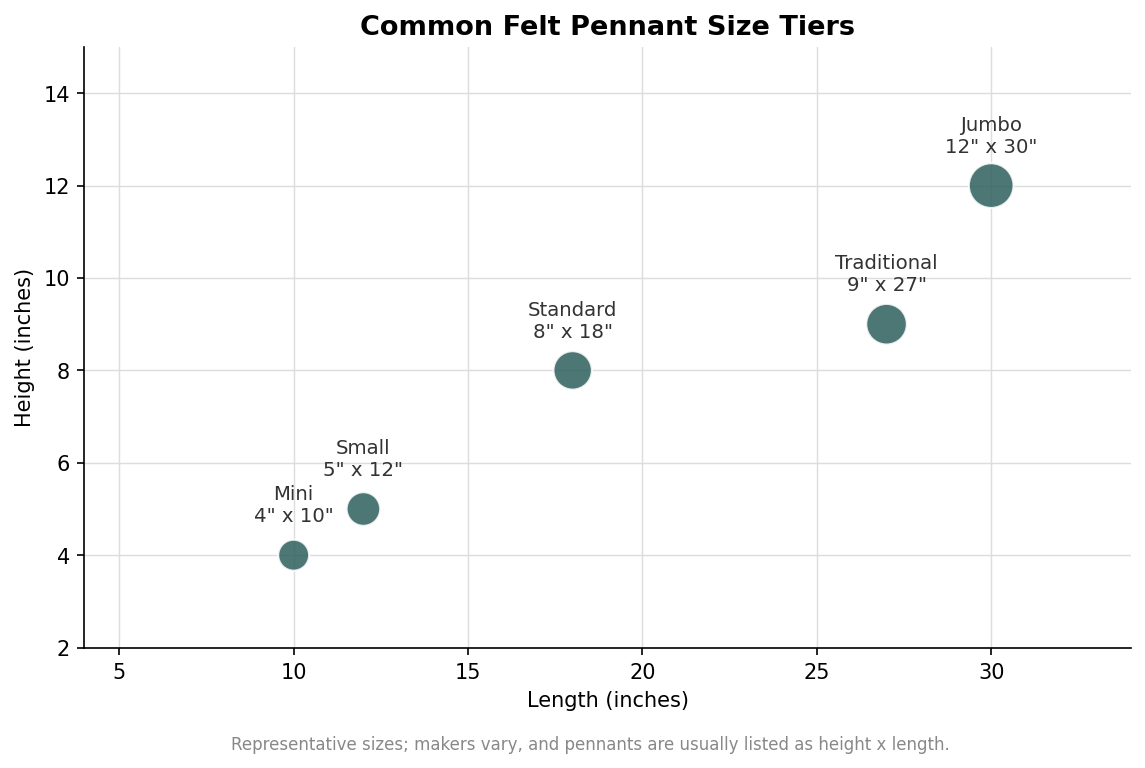
    Felt pennants are usually described as height by length, and they cluster into a handful of common tiers. Mini pennants around 4 by 10 inches are the giveaway size, the thing you hand out at a game or clip to a backpack. A small pennant near 5 by 12 inches is still pocketable but has more room for a name. The workhorse standard sits around 8 by 18 inches, big enough to read across a room and the default for most team and school orders. Traditional college pennants run longer and leaner, in the neighborhood of 9 by 27 inches, which is the classic dorm-wall silhouette. Jumbo pennants of roughly 12 by 30 inches and up are display pieces for a gym wall or a reunion backdrop.

    Pick the size by the job, not by the price. A pennant meant to be mailed as a keepsake wants to be small and light; one meant to hang behind a podium wants length so the shape reads from a distance. If you are unsure, the standard 8 by 18 is the safe middle that photographs well and still ships cheaply.

    Scatter chart of common felt pennant size tiers from mini 4 by 10 inches to jumbo 12 by 30 inches
    Felt pennants cluster into a few standard size tiers; the 8 by 18 standard is the safe middle.

    Wool felt or acrylic felt

    Nearly every custom pennant is cut from one of two materials. Wool felt is the traditional choice, with a dense, slightly textured surface and a heritage look that suits alumni pieces and vintage styling; it is the premium option and priced accordingly. Acrylic or poly felt is the everyday workhorse: it is more affordable, comes in a wider and more consistent range of bright colors, resists fading, and holds up well for giveaways and large runs. For a fundraiser handing out hundreds of pennants, acrylic felt keeps the unit cost sane; for a limited alumni edition meant to last on a wall for decades, wool earns its premium. Neither is wrong, but the choice sets both the tone and the budget, so make it early.

    The decoration method shapes your artwork

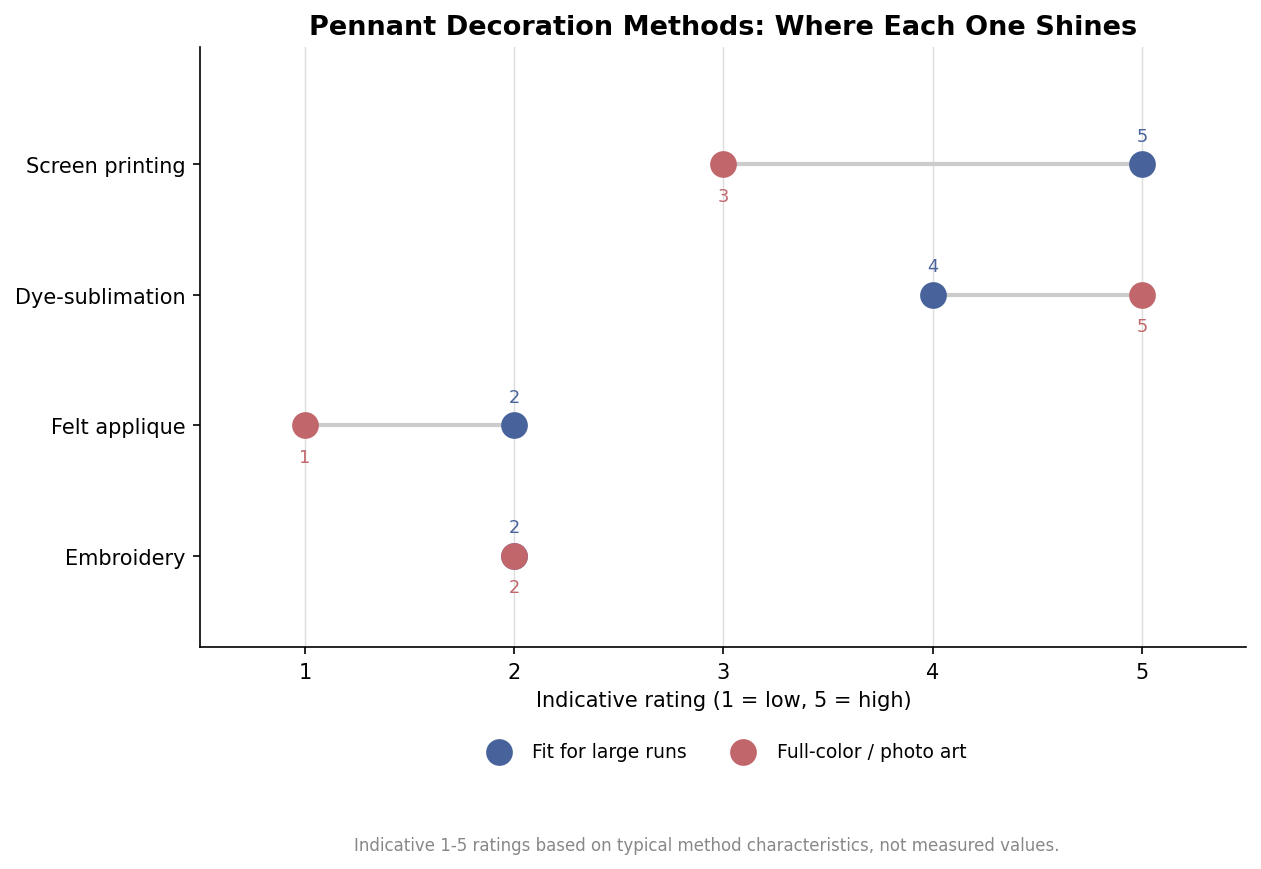
    How the design goes onto the felt matters as much as the design itself, because each method wants a different kind of art. Die-cut felt applique, where letters and shapes are cut from contrasting felt and sewn or heat-bonded on, gives the raised, tactile, old-school varsity look; it is ideal for bold letters and simple shapes but a poor fit for fine detail or gradients. Embroidery adds a stitched, dimensional finish that reads as high quality on names and crests, though large solid areas get expensive in thread. Screen printing lays flat ink onto the felt and is the economical route for high volumes with a limited number of spot colors, which makes it the common choice for giveaway runs. Dye-sublimation prints full color into the fabric and is the method to reach for when a design has photographs, gradients, or many colors, since it reproduces artwork the other methods simply cannot.

    Dot plot comparing screen print, dye-sublimation, felt applique, and embroidery on volume fit and full-color capability
    Match the method to the art: screen print for volume, sublimation for full-color designs.

    The practical takeaway is to decide the method before you finalize the art. A logo with four flat colors and chunky letters is happy as a screen print or an applique; a full-color crest with shading needs sublimation. Trying to force a detailed, multicolor design into an applique will only frustrate everyone involved.

    Finishing turns a shape into a pennant

    A few small finishing choices give a pennant its character. The wide edge can be cut straight or pinked, the zigzag cut, for a classic look. A contrasting header strip sewn across the wide end is the traditional home for a secondary line of text or a year. Tassels or streamers at the point add movement and a spirited, retro feel. You will also decide how it mounts: a slot or sewn sleeve for a wooden stick makes a hand-wave pennant, while a plain header with a sewn loop is meant to hang. Finally, choose single or double-sided. Single-sided is standard and economical, while double-sided costs more but matters when the pennant will be seen from both directions, as it is when hung in the middle of an open space.

    Getting the artwork print-ready

    Whatever method you choose, clean art saves time and money. Supply logos as vector files so they scale to any size without softening, and spell out your exact colors, ideally as Pantone references, so the felt and ink match what you expect rather than a monitor’s guess. Keep text large and high-contrast; on a mini pennant, thin letters and small taglines simply disappear, so a good rule is to design for the smallest size in the order. Ask the printer for a proof and, on larger runs, a physical sample before the full production run, because felt color and print density look different in hand than on a screen.

    Two last logistics are worth nailing down in writing: the minimum order quantity and the lead time. Custom pennants generally get cheaper per piece as the quantity climbs, and retail pricing across sizes and methods can span from a few dollars for a plain mini to several hundred for a large, heavily embroidered display piece, so a per-unit number only means something alongside a quantity. Lead times run longer for embroidery and applique than for a simple screen print, and rush timelines usually exist but cost more, so confirm both before you approve art. Exact minimums, prices, and turnaround vary from one maker to the next, so treat any single figure as a starting point and get your own quote in writing.